


PA 6.6 (Polyamide 6.6)
PA6.6, known as the most durable plastic, also has the highest melting point. It has a semi-crystalline structure. Melting at 265 degrees, PA 6.6 has a continuous use temperature of 120 degrees. As with PA 6, there is a wide variety of products available with various viscosity values, reinforced with glass fiber and similar fibers, rubberized, with high thermal resistance, mineral-filled, flame-retardant, and UV-resistant.
» Unfilled
» Glass Fiber Reinforced
» Glass Bead Reinforced
» Mineral (Talc-Calcite) Reinforced
» Flame Retardant (V0-V1-V2) Reinforced
» UV-Antioxidant-Antistatic Reinforced
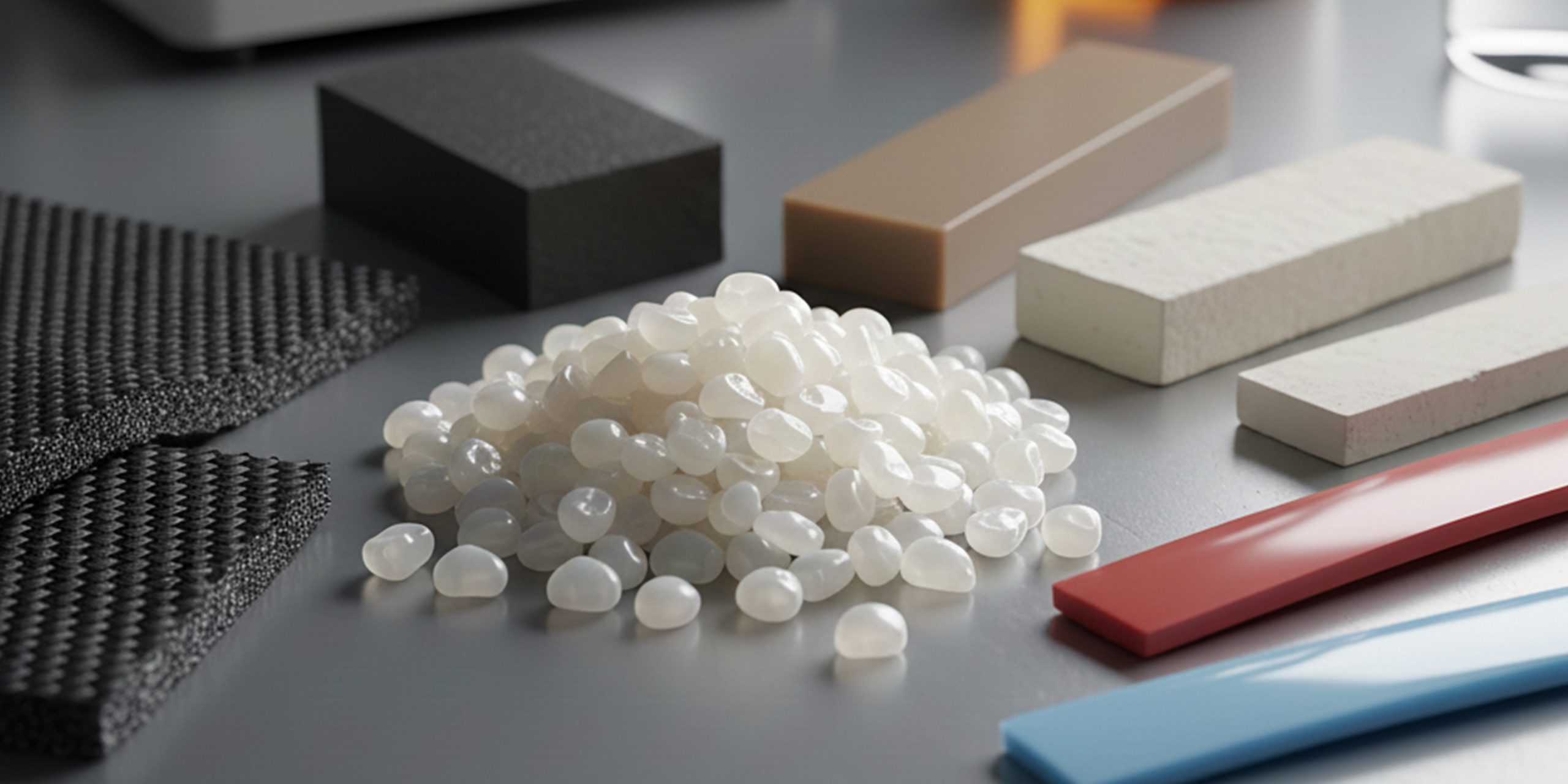
ABS
First of all, the chemical formula of the substance, whose abbreviation stands for “Acrylonitrile Butadiene Styrene,” is (C8H8+C4H6+C3H3N)x. What is ABS plastic? Where is it used? It is a lightweight and hard polymer material widely used in many products manufactured by molding. For example, it is used in remote controls, toys, protective helmets, computer and TV cases, pipe materials, and other products.
ABS plastic is resistant to acids and bases and has excellent electrical insulation properties. ABS plastic material is a copolymer obtained by the polymerization of styrene acrylonitrile in polybutadiene. Its characteristic properties are determined by its composition, which consists of 20% acrylonitrile, 20% butadiene, and 60% styrene. Styrene gives the plastic its gloss and good surface finish. It can be used in temperatures ranging from -20 to 60 degrees Celsius. Its most important features are that it is not harmful to the environment and is used in products with durable bodies.
Features
Environmentally friendly polymer material
Good electrical insulation
Higher chemical resistance
Easier to manufacture
Lightweight and impact-resistant structure
Not affected by water and moisture
Good surface quality

Homopolimer POM
Starting with methanol, if it is polymerized directly, formaldehyde is formed and a POM homopolymer (e.g., Delrin) is created. For POM copolymer, formaldehyde is converted to trioxane, and this is polymerized with a co-monomer to form a POM copolymer (e.g., Hostaform).
Kopolimer POM
POM homopolymer has a higher crystallinity compared to POM copolymer. On the other hand, the chemical resistance of the copolymer is higher. This results in higher hardness for the homopolymer and lower thermal degradation for the POM copolymer during production and in the field.
Where is POM Used?
It is used in the manufacture of precision parts (measuring instruments, watches, pump components, telephone parts, car gauges, etc.), as well as in the manufacture of parts such as cams, gears, pens, keys, valves, window frames, and plastic lighters.
– Gears
– Springs
– Chains
– Screws
– Handles
– Zippers
– Clips
– Fuel pumps
– Breathing apparatus
– Furniture slides
POP AND POE
Plastomers (POP) and Elastomers (POE) are a versatile class of specialty ethylene-propylene copolymers produced using a revolutionary catalyst in conjunction with Dow’s proprietary INSITE™ Technology and Solution Process.
These new polymers are produced using revolutionary technology—this major breakthrough in propylene-ethylene conversion has created new opportunities in many areas, including new applications, new products, and new markets for converters, processors, and formulators.
VERSIFY® Plastomers and Elastomers are designed to enhance properties such as optical, insulation, and heat adhesion performance, elasticity, flexibility, and softness for flexible film and rigid packaging material manufacturers, thermoplastic elastomer and olefin producers, and converters in the consumer products sector.
The unique structure of these new types of polymers offers flexible materials with the following superior properties:
Low modulus, good heat resistance, and excellent optics
Soft touch feel and flexibility
Low heat insulation starting temperatures and a wide heat insulation range
Excellent elastic recovery, thermal adhesion, and clarity
Exceptionally high filler loading and good processability
Excellent compatibility and adhesion with polyolefins, especially PP
Easy processing with various manufacturing methods
The unique structure of POP and POE materials; films, fibers, sheets, and foams with superior properties such as excellent optical, insulation, and heat adhesion performance, elasticity, flexibility, softness, and compatibility in mixtures.